 by Karen Krueger
In January 2008, shortly after my 50th birthday, I walked into the American Center for The Alexander Technique ("ACAT") to begin the three-year journey to becoming a teacher of the Alexander Technique. I would soon leave behind a 25-year career as a big-firm lawyer, a choice I have never regretted.
The Alexander Technique is all about choice: it empowers people to make choices about previously unconscious, habitual or reflexive behaviors and reactions like poor posture, excessive muscle tension and anxiety. Learning the technique through weekly private lessons had enabled me to address the chronic neck pain and headaches brought on by my legal career. It also led me to choose to spend the second half of my life in a different pursuit, by becoming an Alexander Technique teacher. Having decided on this change, I faced another choice: where to train? After learning about the structure of training programs in general, and the differences among them, I had no difficulty deciding that ACAT was the place for me.

I was particularly attracted to ACAT's many faculty members from diverse backgrounds. Most training programs have a single head teacher with a single vision, whose assistant teachers, if any, follow the head's approach. I liked the idea of working with many teachers throughout the week, getting different "takes" on the Alexander Technique, different approaches to the use of hands-on guidance in teaching, different philosophies and pedagogical methods. I thought it could become tedious and limiting for me to work with the few teachers in the same way for the 1600 hours of training.
The Alexander Technique world has several different styles, including those developed by prominent members of the first generation of teachers trained by the Technique's founder, F.M. Alexander: the "Carrington" approach, named for Walter Carrington; the "McDonald" style, for Patrick McDonald; and the Barstow legacy, for Marjorie Barstow. ACAT's faculty includes trainers steeped in each of these three traditions. By its very structure, ACAT never delivers the message that "this way (my way) is the best (or only) way to teach the Alexander Technique." Rather, trainees learn explicitly that there are many choices; they try out different styles and approaches; and they are given the tools to develop their own approach and to be creative in their teaching, rather than simply copying the way someone else does it.
Some people have told me they find this confusing. A trainee at another course that I visited called the ACAT program a "conveyer-belt" approach and said she preferred having one trainer with a consistent message, rather than having one faculty member on Monday say X and another on Friday say Not X. This didn't trouble me, and in fact it turned out to be one of my favorite things about training! I enjoyed thinking about and experimenting with the possibility that X and Not X might both be true, possibly at different moments or in different situations or for different people.
Moreover, there is a consistent vision underlying ACAT's training: a written curriculum setting forth the progression from beginner to graduate, term by term; a strong devotion on the part of all trainers to the fundamental principles of the Alexander Technique, as expressed in F.M. Alexander's own books (required reading for all trainees) and developed by his successors; and a rigorous approach to hands-on practice in a supportive environment. This strong foundation, first laid down by founding teachers Judy Liebowitz and Deborah Caplan, combined with the diverse group of collaborating faculty members, makes training at ACAT like a musical "theme and variations," in which each successive variation both elaborates and embodies the theme.
After three years, I graduated from ACAT confident in my skills and ready to begin teaching on my own. At the same time, I was sad to come to the end of my training, having become very attached to ACAT, its faculty and my fellow trainees. Fortunately for me, ACAT affords its graduates many ways to remain part of the community and to continue learning and improving our skills. I'll write about that in a subsequent post.
Found out more about ACAT's teacher training program here.
And be sure to stop by our next Open House on October 19, 7-9pm—details here.
[author] [author_image timthumb='on']http://www.acatnyc.org/main/wp-content/uploads/2015/10/karen-headshot-67.jpg[/author_image] [author_info]KAREN G. KRUEGER became a teacher of the Alexander Technique after 25 years of practicing law at two major New York law firms, receiving her teaching certificate from the American Center for the Alexander Technique in December 2010. Her students include lawyers, business executives, IT professionals and others interested in living with greater ease and skill. Find her at her website: http://kgk-llc.com. [/author_info] [/author]
 by Brooke Lieb
The Alexander Technique teaches a robust tool to recognize and address habits, including movement patterns, posture and muscle tone; and thinking and behavioral habits, as well.
by Brooke Lieb
The Alexander Technique teaches a robust tool to recognize and address habits, including movement patterns, posture and muscle tone; and thinking and behavioral habits, as well. by Brooke Lieb
ACAT’s
by Brooke Lieb
ACAT’s 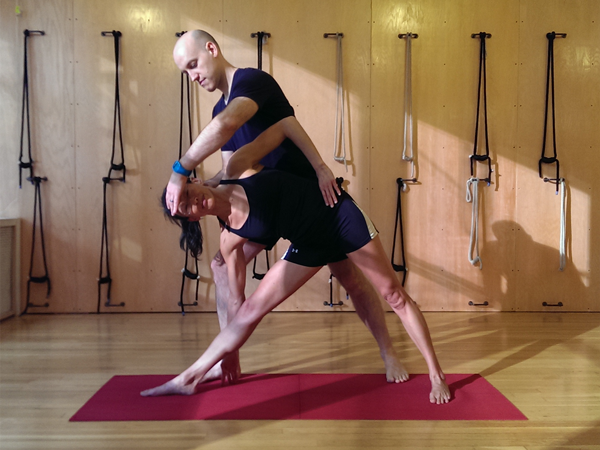 by Witold Fitz-Simon
Yoga teachers giving adjustments has become a
by Witold Fitz-Simon
Yoga teachers giving adjustments has become a  By Mariel Berger
[Many thanks to my Alexander Technique teacher, Witold Fitz-Simon, and my Alexander Technique Psychologist, Jane Dorlester]
By Mariel Berger
[Many thanks to my Alexander Technique teacher, Witold Fitz-Simon, and my Alexander Technique Psychologist, Jane Dorlester]
 by Witold Fitz-Simon
In genre fiction, movies and TV, there is a type of story known as the procedural. The classic version of this type of story is the Police Procedural, best exemplified by the TV show “Law & Order.” The crime is committed and the detective is on the case, using forensics to search out cues, canvassing the neighborhood for potential witnesses and piecing together the truth. A good police procedural can be riveting. Each clue uncovered, each witness questioned can build up to a fascinating portrait of passion, of greed, of intrigue. The Alexander Technique can make your mundane daily routine just as interesting, even without the drama!
by Witold Fitz-Simon
In genre fiction, movies and TV, there is a type of story known as the procedural. The classic version of this type of story is the Police Procedural, best exemplified by the TV show “Law & Order.” The crime is committed and the detective is on the case, using forensics to search out cues, canvassing the neighborhood for potential witnesses and piecing together the truth. A good police procedural can be riveting. Each clue uncovered, each witness questioned can build up to a fascinating portrait of passion, of greed, of intrigue. The Alexander Technique can make your mundane daily routine just as interesting, even without the drama! by Jeffrey Glazer
Recently, I realized that it’s been years since I’ve spent a dime on efforts to get myself out of pain.
by Jeffrey Glazer
Recently, I realized that it’s been years since I’ve spent a dime on efforts to get myself out of pain. by Witold Fitz-Simon
ACAT’s 9th Annual Summer Intensive takes place July 13 - 17, 2015. There are still a few spaces left, for more information and to register, visit our
by Witold Fitz-Simon
ACAT’s 9th Annual Summer Intensive takes place July 13 - 17, 2015. There are still a few spaces left, for more information and to register, visit our 
 by Jeffrey Glazer
 by Dan Cayer
I’m not against correcting our posture or body on principle. I wish all it took to rid ourselves of chronic pain and tension was figuring the right angle or position, and tapping our body into place. It’s such a seductive offer; that we need only arrange our body and then get on with the rest of our day.
by Dan Cayer
I’m not against correcting our posture or body on principle. I wish all it took to rid ourselves of chronic pain and tension was figuring the right angle or position, and tapping our body into place. It’s such a seductive offer; that we need only arrange our body and then get on with the rest of our day. by Witold Fitz-Simon
 by John Austin
There have been
by John Austin
There have been  by Brooke Lieb
I have always taken having good balance for granted. Since I was a small child, standing on one leg, walking along a balance beam and other activities that require balance on one leg have been easy for me. In ballet class, I could go up on demi-pointe on one foot and stay easily balanced for an indefinite amount of time. I have come to appreciate this is due in no small part to the luck of the genetic lottery. I’ve had my share of near misses, and the occasional tumble, and as the years progress, I can tell my Alexander training has given me better balance and coordination, even if I started off fairly well to begin with.
by Brooke Lieb
I have always taken having good balance for granted. Since I was a small child, standing on one leg, walking along a balance beam and other activities that require balance on one leg have been easy for me. In ballet class, I could go up on demi-pointe on one foot and stay easily balanced for an indefinite amount of time. I have come to appreciate this is due in no small part to the luck of the genetic lottery. I’ve had my share of near misses, and the occasional tumble, and as the years progress, I can tell my Alexander training has given me better balance and coordination, even if I started off fairly well to begin with.
 by Witold Fitz-Simon
Eye strain is an increasing problem for many of us in our digital world. Our eyes were not built to be constantly staring at a fixed point with a bright light shining straight at them for several hours at a time. They are, in fact, incredibly skilled at tracking the movement of all the things in our environment, as well as moving around themselves, but once you fix your gaze on something for an extended period of time, all sorts of mechanisms can start to go wrong.
by Witold Fitz-Simon
Eye strain is an increasing problem for many of us in our digital world. Our eyes were not built to be constantly staring at a fixed point with a bright light shining straight at them for several hours at a time. They are, in fact, incredibly skilled at tracking the movement of all the things in our environment, as well as moving around themselves, but once you fix your gaze on something for an extended period of time, all sorts of mechanisms can start to go wrong.